

Our name has changed as our responsibilities have grown. The commitment to health research, training and evidence for Zambia has remained.

Five decades of scientific work
A foundation that continues to grow
The institute’s foundation in 1975 underpins five decades of research, partnerships, diagnostic support and scientific development.
From a regional research centre to a national institute, the journey connects an expanding scientific agenda with the health needs of Zambia.
Our institutional journey
-
1975
A regional research foundation
The World Health Organization established the Tropical Diseases Research Centre as a regional centre for Africa.
-
1981
A national centre
TDRC became a national centre, initially focused on malaria, human African trypanosomiasis and schistosomiasis.
-
1982
A statutory institution
The TDRC Act No. 31 of 1982 established the centre’s statutory foundation under Zambian government custodianship.
-
Following decades
An expanding research agenda
Work grew to include HIV, tuberculosis, micronutrient deficiencies, diarrhoeal disease and other health priorities.
-
2024
The NHRTI mandate
Act No. 13 of 2024 continued TDRC as the National Health Research and Training Institute with a broader research and training mandate.

From TDRC to NHRTI
A wider role, built on scientific experience
Established in 1975 as a World Health Organization regional centre, TDRC became a national centre in 1981 and a statutory research institution in 1982. Its early work focused on malaria, human African trypanosomiasis and schistosomiasis.
As Zambia’s health priorities changed, its research widened to include HIV, tuberculosis, micronutrient deficiencies, diarrhoeal diseases and other conditions. Teams built expertise in epidemiology, clinical and biomedical research, medicines and health interventions, social science, surveillance and public health.
The centre also helped train health workers and researchers and generated evidence for health policy and practice. Its transition to NHRTI brought a broader national mandate for health research, research training, capacity development, knowledge translation and stronger research governance and ethical standards.
Today, the institute builds on that legacy through research into national and emerging health priorities, professional development and partnerships that help turn evidence into programmes and practice.
Directors who shaped the institute
This institute-supplied portrait montage recognises former and current directors of TDRC and NHRTI. Names and service dates are shown in the original graphic.
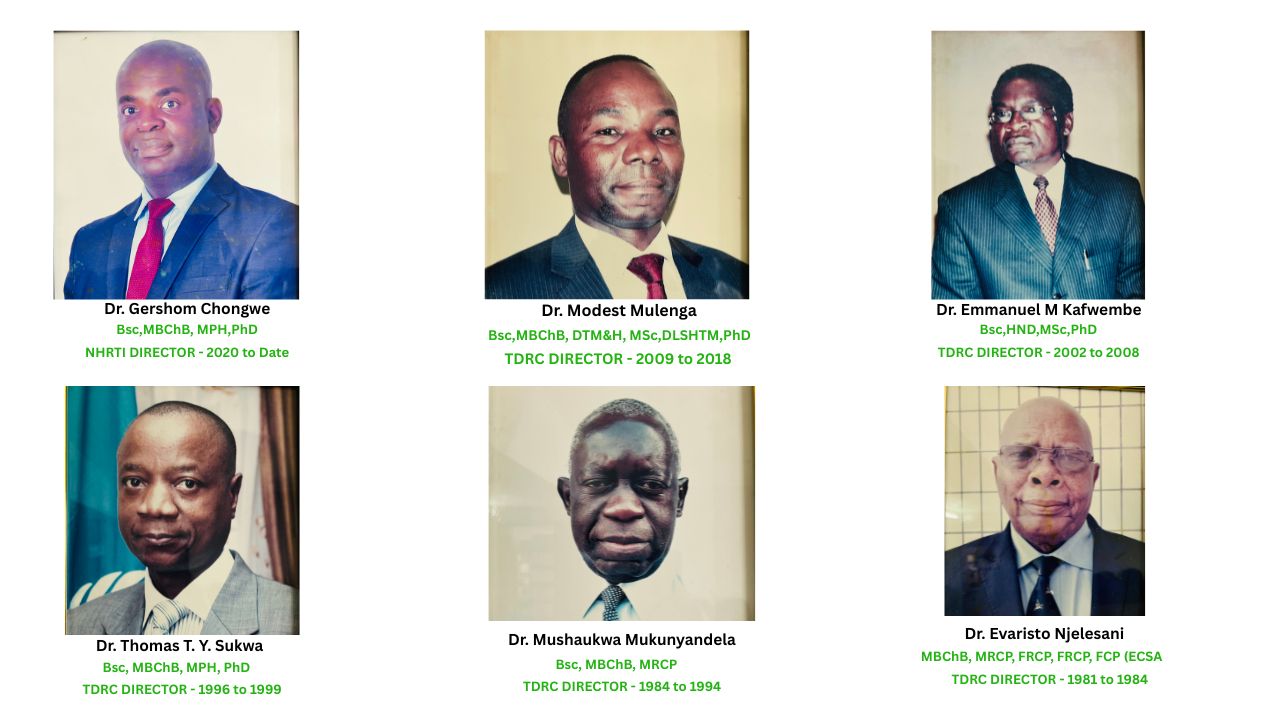 Open the full-size portrait montage

Golden Jubilee Honours
Recognising Pioneering Leadership
During the Golden Jubilee celebrations marking 50 years of health research, NHRTI honoured pioneering leaders who built the institution’s enduring scientific legacy. First Director Prof. Njelesani was presented with the award for Distinguished Service in Health Research and Training, celebrating his foundational leadership and lasting impact.
A continuing legacy
The next questions are already taking shape
Explore the institute’s research portfolio and the connections between long-term scientific work, communities and health services.